
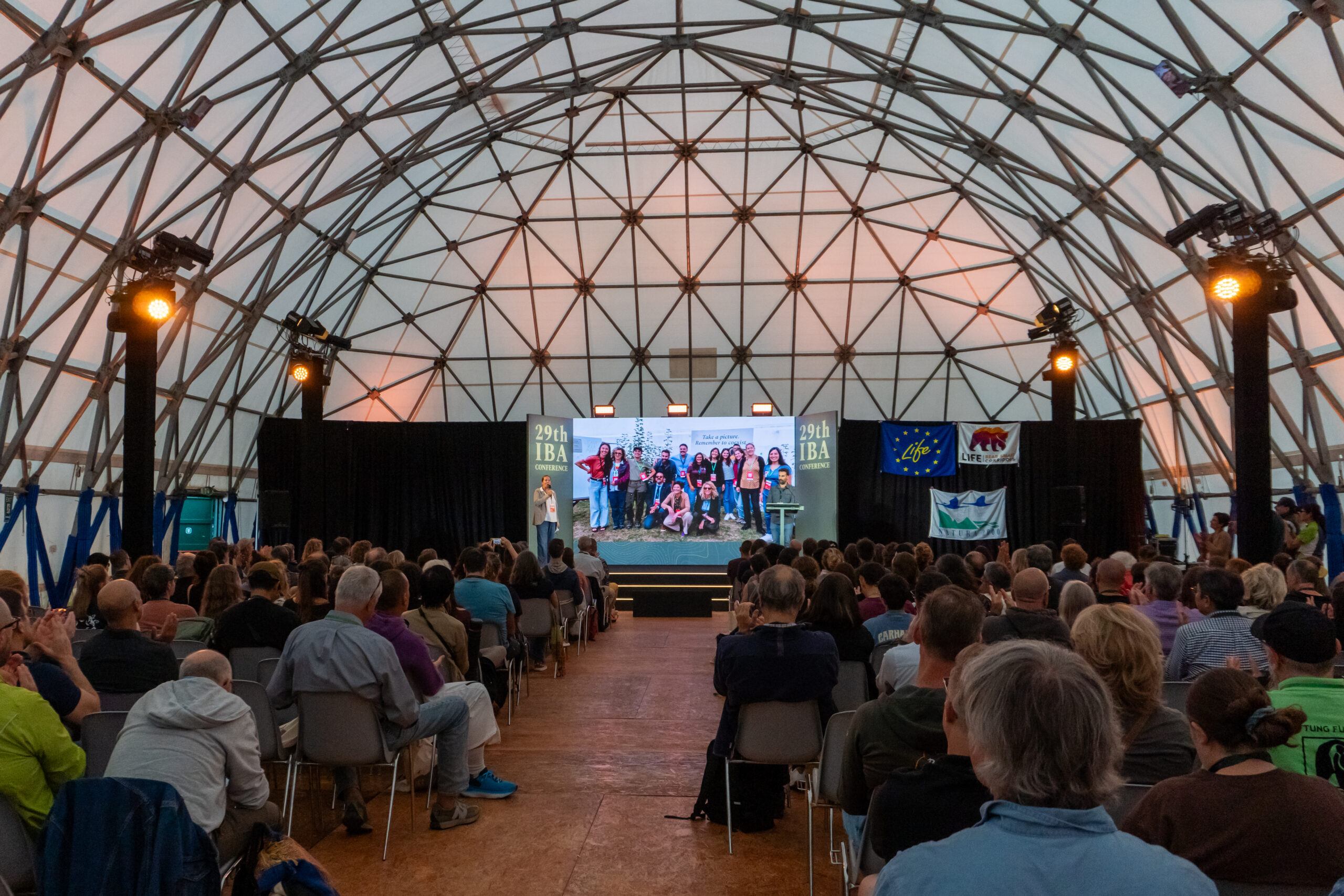
More than 150 people took part in the closing event in Pescasseroli, marking the culmination of five years of work to build a possible and lasting coexistence between people and bears.
At the heart of the project, for the first time with such a strong focus, were local communities: 16 Bear-Smart Communities, hundreds of prevention measures, and a network of relationships that today represents one of the project’s most important achievements.
Some projects can be told through numbers. And then there are those that, beyond the numbers, leave behind something harder to measure: relationships, awareness, new forms of collaboration, and the ability to tackle together problems that once seemed to belong to entirely different worlds.
The LIFE Bear-Smart Corridors project belongs to both categories.
On Sunday, September 20, in Pescasseroli, more than 150 people took part in the project’s closing event, organised as part of the 29th Conference of the International Association for Bear Research and Management (IBA). It was an opportunity to look back on five years of work dedicated to the conservation of the Marsican brown bear and, above all, to reflect on a journey that chose to place at its centre a word that is simple to say, but far more complex to build: coexistence.
The underlying idea of the LIFE Bear-Smart Corridors project was clear: if we want bears to continue living and expanding their range across the central Apennines, it is not enough to work on habitat or monitor the population. We also need to work on the territories where people live, on economic activities, on potential sources of conflict, and on the relationships among those who live and work in these areas.
To achieve this, the project chose to start with local communities.
Sitting down at the same table.
At the heart of the project were the Bear-Smart Communities and their local committees.
Over five years, 16 of these communities were established across the central Apennines, bringing together local authorities, associations, farmers, livestock breeders, business operators, citizens and other stakeholders. People with different needs and perspectives who chose to come together to talk about their communities, their territory and the presence of bears.
The goal was not to eliminate conflict, nor to find a one-size-fits-all solution. It was, first and foremost, to learn how to address it together.
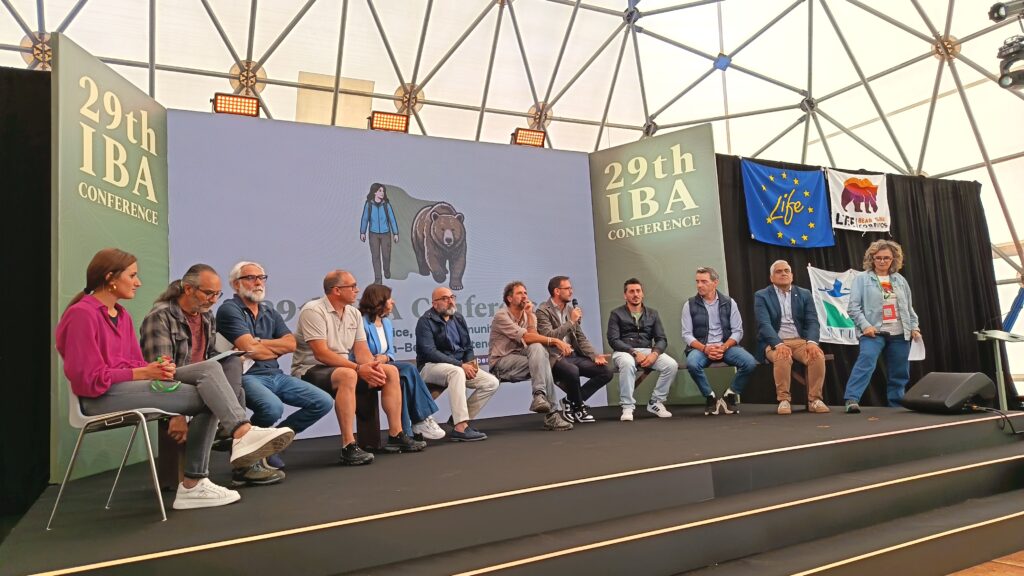
During the final event, representatives of the Committees from Campoli Appennino, Lecce dei Marsi, Morino, Ortona dei Marsi, Pettorano sul Gizio, Pizzone, Scanno, Vastogirardi and Villetta Barrea shared what this journey has meant to them.
Sitting around the same table made it possible to better understand the needs and challenges faced by different groups. Working together on maps meant learning to look at their own territory through new eyes, identifying places and situations that could pose risks to people, livelihoods or bears.
It is a less immediate result than an installed fence or a replaced waste bin, but perhaps just as important: the building of a common language and a shared sense of responsibility.
From words to actions.
However, the work of the Bear-Smart Communities did not remain limited to dialogue.
Over five years, the project delivered a wide range of concrete measures to prevent and mitigate problematic interactions between people and bears.
A total of 27 water tanks were made safer, more than 700 damage-prevention measures were put in place—including electric fencing, bear-proof chicken coops and gates—and over 150 bear-proof waste bins were installed.
In addition, 82,000 metres of abandoned barbed wire were removed from the mountains, helping to reduce a real hazard for wildlife and, in particular, for bears.
These actions were complemented by 90 interventions carried out by the Bear Intervention Units, designed to rapidly address situations of potential conflict and reduce associated risks through prevention and mitigation measures.
The project also focused on knowledge and awareness-raising, engaging more than 1,000 young people. through educational activities and by promoting community engagement initiatives. These included: Condominio selvaggio, a theatre performance created to explore the complexity of living alongside wildlife through a language different from those traditionally used in conservation.
Numbers that, as Mario Cipollone, Director of Rewilding Apennines, pointed out, exceeded the project’s initial targets.
In Greece too, where the project worked with communities in the northern part of the country, prevention and local engagement activities were developed. During the event, Spyros Psaroudas, Director of Callisto, presented the results achieved in the Greek project area.
A network that goes beyond the project.
One of the elements that made this work possible was collaboration among different stakeholders.
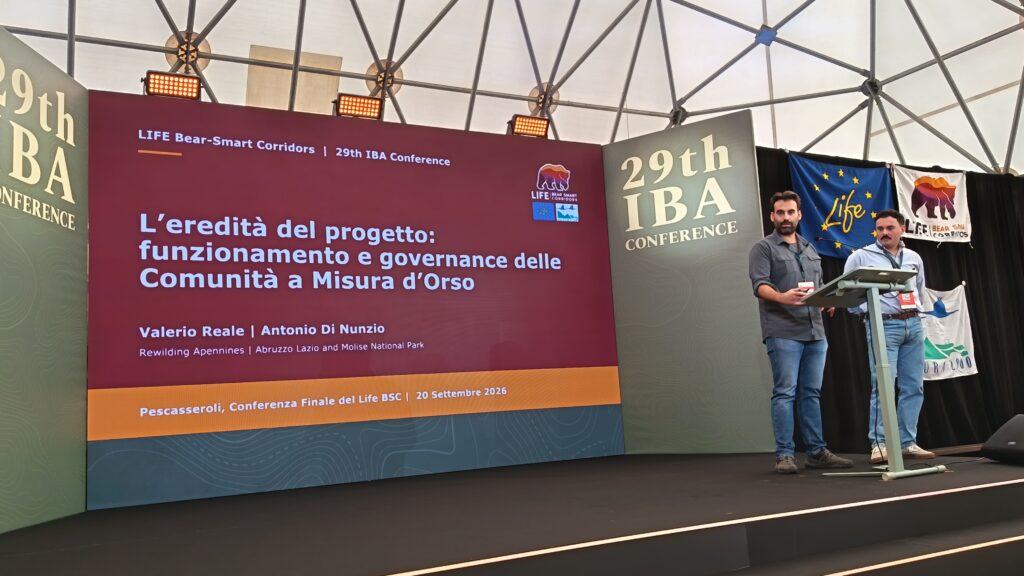
In Pescasseroli, Valerio Reale of Rewilding Apennines and Antonio Di Nunzio of the Abruzzo, Lazio and Molise National Park explored the socio-economic context of the Bear-Smart Communities, how their governance works, and the role of the local committees.
The project brought together institutions, protected areas, local authorities, associations, the scientific community and local communities, enabling different expertise and tools to converge towards a common goal.
This is particularly important when it comes to conservation. The presence of bears cuts across different areas of expertise and responsibilities: it concerns wildlife management, but also agriculture, livestock farming, tourism, safety, spatial planning and the everyday life of local communities.
No single organisation can address all these aspects on its own.
What does the future hold for the Marsican brown bear?
The event in Pescasseroli was also an opportunity to look beyond the end of the project.
In a roundtable discussion moderated by Luciano Sammarone, Director of the Abruzzo, Lazio and Molise National Park, and Valerio Reale, Enterprise Manager at Rewilding Apennines, participants discussed the future of the Marsican brown bear and the need to find a balance between the expansion of its range and the economic sustainability of the areas concerned.
A topic that is set to become increasingly important.
If the Marsican brown bear population were to expand its range, the number of areas having to adapt to its presence would also increase. The model tested by the LIFE Bear-Smart Corridors project could therefore provide a starting point for supporting this process, adapting it to the specific characteristics of the new communities involved.
A second discussion, moderated by Valeria Barbi, environmental journalist and Head of Communications at Salviamo l’Orso, focused instead on the broader issue of bear conservation policies.
From the Apennines to Europe
The work carried out through the Bear-Smart Communities did not end with the closing event.
On Tuesday, September 22, during the second day of the IBA conference, the experience of the Bear-Smart Communities and their local committees was presented to the international scientific community, with a talk of Serena Frau, Project manager of Salviamo L’Orso.
The model attracted particular interest precisely because of its decision to place communities at the heart of coexistence processes and make them active participants in conservation strategies.
This is an important recognition, because international exchange provides an opportunity to test the experience gained locally by comparing it with realities and approaches developed in other areas where bears and people share the same spaces.
At the same time, it allows the experience gained here to be shared beyond the Apennines.
The project ends. The work doesn’t.
The conclusion of a LIFE project necessarily marks an ending. A funding period comes to an end, the project structure is brought to a close, and the work carried out is assessed.
But in the case of the LIFE Bear-Smart Corridors project, what remains may be more important than its formal duration.
16 Bear-Smart Communities remain.The committees and the relationships built within them remain. So do prevention tools, expertise, experience and a network that, over the past five years, has learned to work together. Above all, what remains are communities that are now better equipped to recognise risks, discuss them and seek shared solutions.
The challenge in the years ahead will be to ensure that none of this is lost. It will be necessary to strengthen institutional recognition of the Bear-Smart Communities and identify the tools, responsibilities and resources needed to keep this model active beyond the end of the project.
It will be equally important to understand where and how to replicate the model, supporting the bear’s potential expansion into new areas and new communities.
The LIFE Bear-Smart Corridors project may be coming to an end, but this is not the end of the story.
A project comes to an end, and perhaps the most challenging part begins: ensuring that what has been built over these five years continues to thrive in the communities and territories where it took root.
In the photos, some moments from the final conference of the LIFE Bear-Smart Corridors project.