

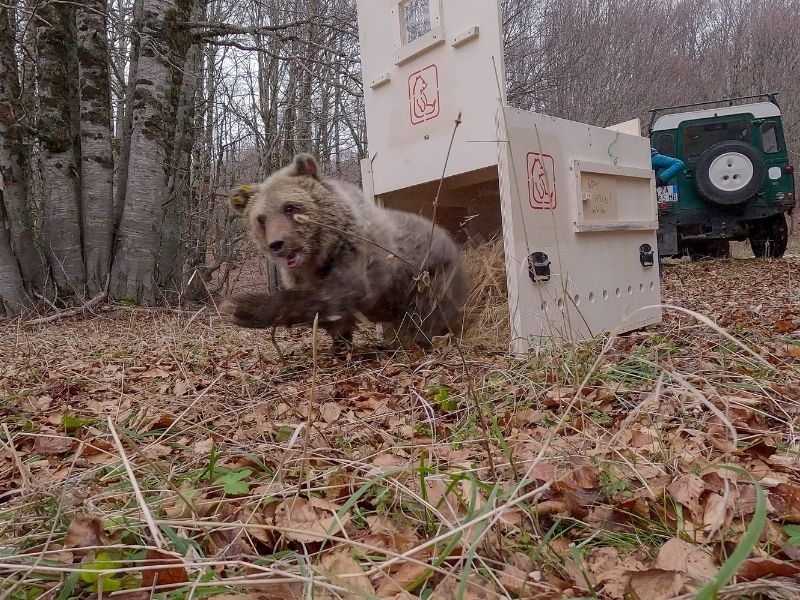
At the end of December, one of the most delicate and significant moments of Marsican brown bear conservation work came to an end: Nina returned to the wild.
The release of the bear cub was followed with great attention by the Park’s Scientific and Veterinary Service, along with the Supervisory Service, who accompanied every step of this complex and responsibility-laden journey. Before returning to the wild, Nina underwent a thorough health examination, as required by the Guidelines for the release of Marsican brown bear cubs into the wild, to ensure the best conditions of health and adaptation to the natural environment.
As the Abruzzo, Lazio and Molise National Park, which has been involved with the bear from the beginning and has followed all phases of its management in the protected area and release into the wild, makes known, in the weeks before its return to the wild, the bear’s diet had been progressively reduced and its behavior had shown clear signs of change: more time spent in the den, less activity, a slowing metabolism. All indications of approaching hibernation. Having also carefully evaluated the many environmental variables-from weather conditions to the characteristics of the release sites-the technicians determined that this was the right time to return her to freedom.
The locations identified for release meet strict criteria: areas within the Park, presence of potential wintering sites, low anthropogenic pressure, and a significant distance from population centers and human activities. Key elements to increase the chances of success of such a complex operation.
Decisive, as always, were the bear’s weight and behavior. At 38 kilograms, Nina has reached a condition considered adequate to cope with winter, marking a crucial step toward independence.
The release took place with the utmost discretion, for unavoidable security reasons, the same that will now characterize the monitoring phase. Indeed, Nina is equipped with a GSM radio collar, which will allow her movements to be tracked remotely without interfering with her wildlife.
Park Director Luciano Sammarone said that “Now the most delicate part begins: monitoring her from a distance and hoping with all our might that Nina will be able to live free, in her natural environment, contributing to the survival of her species.”
Our association welcomes this news with great enthusiasm, the first positive news since the bad incident involving a bear in a car accident and resulting in its death. We hope, then, that Nina will be able to fully resume her wild life, explore, choose and grow as every young bear should be able to do. Each release is a challenge, but also an act of trust in Nature and in the work of those who work every day for the conservation of the Marsican bear.
And while it is true that not all releases have a successful outcome, as experiences in Europe and North America show, we can only wish Nina the simplest and most powerful wish: may she live free and happy, in the woods that have always belonged to her species.
Cover photo: Umberto Esposito