

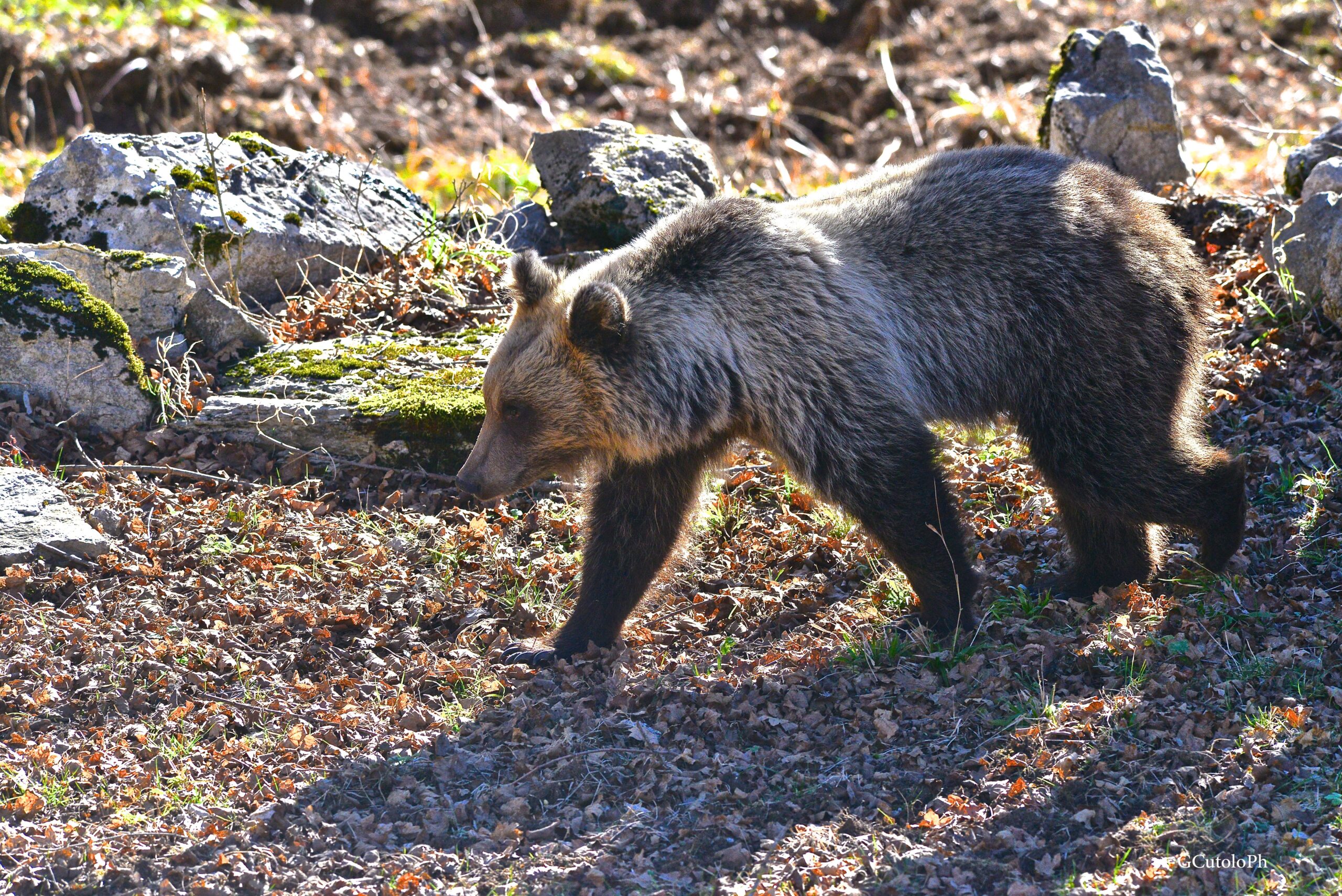
Today, July 16, 2026, at the Ministry of the Environment and Energy Security (MASE), the results of the first population estimate of the Marsican brown bear were presented, based on a survey of the subspecies’ entire range. This marks a historic moment for bear conservation, in which Salviamo l’Orso participated alongside ISPRA, the Abruzzo, Lazio and Molise, protected areas, the regions, the Carabinieri Forestali, and the many organizations that have contributed in recent years to the monitoring and protection of this species, which is unique in the world.
For the first time, we have a comprehensive picture of the population thanks to a genetic survey covering more than 6,000 square kilometers of the central Apennines, conducted in the summer of 2025 as part of the DigitAP project, funded by the PNRR.
The findings represent a major milestone: the population is estimated at 81 Marsican brown bears, with a confidence interval ranging from 73 to 88 individuals. Of these, 43 are estimated to be females and 38 males.
An important achievement, built together
This achievement is the result of a collaborative effort involving dozens of organizations and hundreds of people who worked on collecting biological samples, conducting genetic analyses, and processing the data.
Salviamo l’Orso has also made a tangible contribution to monitoring efforts through its staff and a network of volunteers who have been working in the field for years to protect the Marsican brown bear. This daily, often behind-the-scenes commitment complements research efforts, conflict prevention, and outreach to local communities. It is also thanks to this widespread work that we now have solid, reliable data on which to build future conservation strategies.
Collaboration among institutions, scientific research organizations, protected areas, and associations has once again proven to be one of the most effective ways to protect one of Europe’s rarest and most endangered species.
Having a robust, widely accepted estimate means being able to better plan future conservation efforts and measure the effectiveness of conservation measures over time.
The Abruzzo, Lazio, and Molise National Park remains the heart of the region
The results confirm that the core population continues to be concentrated in the Abruzzo, Lazio, and Molise National Park and its Contiguous Zone, where the population size appears to be essentially stable or slightly increasing compared to the previous estimate from 2014, which indicated approximately 50 individuals.
This is positive news, but not surprising. The historic area already has a very high density of bears, likely close to the ecological limits that the territory can support.
For this reason, the future of the Marsican brown bear depends not so much on an increase in the number of bears within the park as on the species’ ability to expand steadily into the surrounding areas.
The real challenge is expansion
One of the most significant aspects of the study concerns the areas outside the historic center, where the bear population is estimated at 16, with a range of 9 to 22 individuals.
This is an encouraging sign: it means that many areas of the central Apennines are already suitable for the permanent presence of the Marsican brown bear. But it is also a call to responsibility.
For this expansion to continue, we need connected habitats, functioning ecological corridors, and a tangible reduction in the main causes of human-induced mortality: road construction, poaching, poisoning, unsafe infrastructure, and conflicts with human activities.
Bear conservation, therefore, cannot be limited to the boundaries of protected areas. It must involve local governments, regions, communities, livestock farmers, farmers, citizens, and all organizations operating in the area. It is precisely in these areas that Salviamo l’Orso has focused much of its efforts for years, promoting prevention, safety, and coexistence initiatives that today represent one of the most effective tools for supporting the species’ natural expansion.
A starting point, not a destination
The estimate presented today represents much more than just a number.
It is an essential tool for understanding how one of Europe’s smallest and most valuable bear populations is evolving and for guiding future conservation strategies.
For Salviamo l’Orso, this result confirms two key points. On the one hand, the investments made over the past few decades to protect the Marsican brown bear are yielding concrete results. The population’s growth and the bear’s increasingly stable presence even beyond the park’s boundaries demonstrate that collaborative efforts among institutions, protected areas, the research community, associations, and local communities can yield tangible results. Salviamo l’Orso, too, through the daily work of its staff and volunteers, has helped pave this path, demonstrating just how integral the role of civil society has become to conservation policies.
Precisely for this reason, the results presented today raise a question that cannot be ignored. If biodiversity conservation, conflict prevention, and the coexistence of humans and large carnivores are yielding concrete results, how does this align with the government’s current policy direction and its support for the hunting bill, which risks undermining the wildlife protection system built up over the past few decades?
The conservation of the Marsican brown bear is no accident. It is the result of forward-thinking policy decisions, public investment, scientific research, regulations, prevention efforts, and the patient process of building a harmonious relationship with local communities. Weakening this framework would jeopardize a legacy built over decades of work.
The Marsican bear remains a subspecies critically endangered with extinction. Eighty-one individuals is an encouraging result, but it does not mean we can let our guard down. Every preventable death, every fragmented habitat, and every decision that reduces the level of protection can jeopardize a balance that remains extremely fragile.
That is why Salviamo l’Orso will continue to work in the field, alongside institutions, the research community, and local communities, to ensure that the species can continue to expand safely. But today we also call on policymakers to draw the most important lesson from these findings: when we invest in conservation, scientific knowledge, and coexistence, nature responds.
It would be incomprehensible if, just as such solid evidence of the effectiveness of conservation policies is emerging, the country were to choose to take a different path. The protection of biodiversity cannot be subordinated to a vision that views wildlife as a problem to be managed with tools increasingly geared toward harvesting. The Marsican brown bear, a symbol of the Apennines and of Italian biodiversity, deserves consistency. And the results presented today demonstrate that the path to follow is that of conservation, not a retreat from it.
Cover photo of the bear: Giampiero Cutolo